
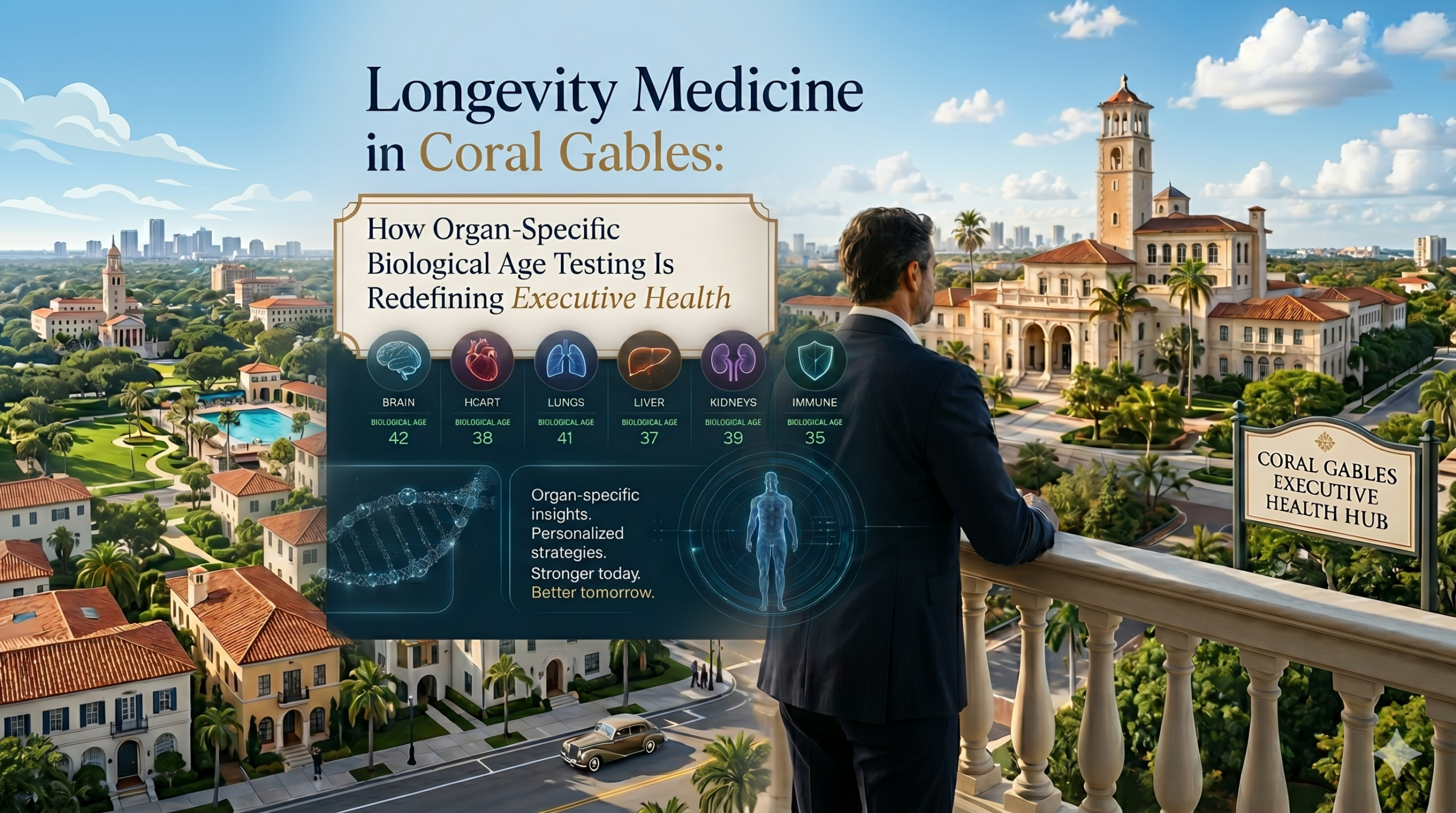
Longevity Medicine in Coral Gables: How Organ-Specific Biological Age Testing Is Redefining Executive Health
Exploring Longevity Medicine Coral Gables
The comprehensive executive physical has driven prevention for three decades — and in 2026, biological age testing is the next stage of precision medicine layered on top of it. Peer-reviewed research from Stanford, Duke, and the UK Biobank in 2025 validated organ-specific biological age testing as a measurable predictor of disease, longevity, and intervention response. At PURE Executive Health & Wellness in Coral Gables, board-certified physicians integrate these advances — proteomic organ clocks, second-generation epigenetic clocks like GrimAge and DunedinPACE, full-body MRI, DEXA, and VO2 max — with the deep clinical interpretation a precision longevity program requires, Supporting cellular health as a foundation for personalized longevity medicine.
Executive Physicals Work — and Biological Age Testing Miami Is the Next Stage of Precision Medicine Miami
The comprehensive executive physical has earned its place. For three decades, the discipline of pulling the right data together — full lipid and lipoprotein subfraction panels, blood pressure and ambulatory monitoring, EKG and stress testing, advanced cardiometabolic and inflammatory markers, hormone profiles, and imaging where indicated — has driven real prevention. When that data is gathered carefully and interpreted by a physician who knows what to do with it, executive physicals work, and they remain the foundation of any serious longevity program. PURE has practiced that discipline since the day the doors opened in Coral Gables.
What has changed in 2026 is what can be layered on top. Biological age testing in Miami — second-generation epigenetic clocks, organ-specific proteomic panels, and validated functional biomarkers — gives the physician a new layer of resolution and provides a comprehensive view of health and aging. Various scientific methods, such as DNA methylation analysis, proteomic analysis, and telomere length measurement, are now used to assess biological age with greater accuracy. The traditional physical answers where a patient stands today; the new biomarker stack adds a quantitative read on the rate at which each major organ system is accumulating aging burden. According to research published in Nature Aging in 2025, plasma proteomic measurements of 11 organs in a UK Biobank cohort of 44,498 individuals produced organ-age estimates that predicted heart failure, COPD, type 2 diabetes, and Alzheimer’s disease onset across 17 years of follow-up — independent of clinical and genetic risk factors.
For a 52-year-old founder living in Coral Gables, this is an additional clinical conversation, layered onto the executive physical rather than replacing it. Biological age reflects the actual state of your cells, tissues, and organ systems, and can differ significantly from chronological age, which is simply the number of years you have been alive. The physical answers “where is this patient today?” The new biomarker stack adds “which organ system is aging fastest, and what is the most evidence-supported way to slow it before clinical disease appears?” Both questions matter, and the value of either depends entirely on having a physician who understands how to interpret the data and translate it into a written plan. That integration is the next stage of longevity medicine in Coral Gables — and it is exactly the work PURE was built to do. Personalized health plans are developed using a comprehensive analysis of biomarkers to tailor interventions that address individual health needs and goals, including assessment of lifestyle factors and diet as key components influencing biological age and overall health.
Inside the 2026 Science: Epigenetic Clocks, Proteomic Aging, and Organ-Level Precision
Three branches of biological age science have matured in parallel and now operate as complementary tools inside a serious longevity medicine program.
Second-generation epigenetic clocks. GrimAge, PhenoAge, and DunedinPACE are DNA methylation–based biomarkers that measure aging at the cellular level. These epigenetic clocks were developed by leading research institutions using advanced scientific methods, ensuring their accuracy and reliability. A 2025 Nature Communications study comparing 14 epigenetic clocks across 18,859 individuals confirmed that second-generation clocks meaningfully predict disease incidence and all-cause mortality, particularly for respiratory and hepatic conditions. DunedinPACE is unique among them: rather than estimating a static “biological age,” it measures the current pace of aging — years of biological aging per calendar year — and was the first methylation clock shown in a randomized controlled trial (the CALERIE caloric restriction RCT) to slow in response to an intervention.
Proteomic organ clocks. The 2025 Nature Aging work from Stanford colleagues, alongside the Whitehall II analysis published in The Lancet Digital Health, established that plasma proteomics can resolve aging at the level of individual organs — brain, heart, kidney, liver, immune system, and others. The clinical implication is striking: in the UK Biobank cohort, an accelerated brain age conferred Alzheimer’s risk comparable to a single APOE4 allele (hazard ratio ~3.1), while a youthful brain age was protective at a magnitude comparable to two APOE2 alleles, independent of APOE genotype.
Functional and imaging biomarkers. Cardiorespiratory fitness measured by VO2 max, body composition by DEXA, and full-body MRI complete the picture. A 2018 JACC analysis of 122,000 patients demonstrated that elite cardiorespiratory fitness was associated with roughly 80% lower all-cause mortality compared to low fitness — an effect size that exceeds most pharmacologic interventions.
These tools utilize various methods, including DNA methylation analysis, proteomics, and advanced imaging, to measure biological age with scientific precision. Test results from these methods are essential for assessing biological age, guiding personalized interventions, and tracking progress in slowing the aging process over time.
Used together, these tools convert “longevity medicine” from an aspirational phrase into a measurable clinical discipline. That integration is the working definition of precision medicine Miami practitioners now deliver to patients who can afford the most thorough assessment available. Exciting innovations in the field include biohacking technologies such as infrared saunas and red-light therapy for cellular repair and wellness.
How a Precision Medicine Miami Practice Translates Bio-Age Data Into Clinical Action
Raw biological age numbers are not the deliverable. Action is. The value of an executive health assessment Miami physicians design around these tools sits in three places. The process begins with a comprehensive assessment to identify risk factors and areas for improvement, using advanced diagnostics to treat the root causes of aging at a cellular level rather than just responding to disease symptoms.
Risk stratification. When a patient’s brain age clock runs eight years older than chronological age, the conversation moves immediately to APOE testing, ApoB and Lp(a), high-sensitivity inflammatory markers, sleep architecture, and neurocognitive baselining. Identifying underlying causes, not just symptoms, is crucial for developing effective strategies. When the cardiovascular organ clock is the outlier, the program emphasizes coronary calcium scoring, advanced lipoprotein subfraction analysis, and structured cardiorespiratory training calibrated to VO2 max.
Intervention selection. Several treatments now have peer-reviewed evidence of moving the relevant clocks. Caloric restriction with adequate protein slowed DunedinPACE in the CALERIE RCT. Resistance training and Zone 2 cardiovascular training improve VO2 max and DEXA-measured lean mass on a months-to-quarters timeframe. Hormone optimization, where clinically indicated, addresses the metabolic substrate that several clocks track. Carefully selected supplementation and pharmacotherapy round out the toolkit when the data justify them. These treatments target metabolic health and inflammation to prevent, delay, or reverse age-related illnesses. Personalized health strategies utilize genetic testing, imaging, and continuous data from wearables to create a tailored health blueprint. Effective personalized health plans can include lifestyle modifications such as dietary changes, exercise regimens, increased physical activity, and stress management techniques to improve overall wellness and longevity.
Longitudinal measurement. The single most useful feature of these biomarkers is repeatability. A patient’s GrimAge or DunedinPACE 12 months after the first reading tells the physician — and the patient — whether the program is working. Tracking test results and progress is essential for maintaining control over health outcomes and achieving better health. These interventions can help patients feel younger and maintain a younger biological profile, supporting a healthier, more vibrant life. That is a feedback loop the traditional executive physical never provided.
The personalized plan developed from this process is designed to promote better health and overall wellness. To take control of your health and longevity, schedule a consultation as the first step toward your personalized longevity medicine plan.
What PURE’s Longevity Program Looks Like in Coral Gables
PURE Executive Health & Wellness operates from Coral Gables and serves patients across nine Miami neighborhoods, including Fisher Island, Indian Creek, Coconut Grove, Brickell, Pinecrest, and Key Biscayne. PURE’s longevity program — the most comprehensive executive physical available in South Florida — is built on four phases and offers a wide range of services, including preventative care, regenerative treatments such as IV nutrient drips and cellular rejuvenation therapies designed to enhance daily performance, medical weight loss programs, and common concierge services such as 24/7 phone access, same-day appointments, and short waiting times. Personalized care is provided with a focus on enhancing natural appearance through subtle, individualized treatments.
Phase 1: Comprehensive baseline. A multi-day evaluation provides a full picture of your health by integrating a full-body MRI, DEXA body composition, VO2 max with metabolic cart analysis, advanced cardiometabolic and lipoprotein panels, hormone profiles, APOE genotyping, and second-generation epigenetic clocks. Where clinically indicated, organ-specific proteomic panels are added. Test results from these advanced diagnostics are used to assess biological age and identify areas for intervention.
Phase 2: Synthesis with the medical director. Every patient receives a personalized consultation with the medical director, resulting in a written longevity blueprint. The blueprint is not a list of supplements; it is a prioritized clinical plan — what to address first, what to monitor, and what the expected response should be at three, six, and twelve months.
Phase 3: Execution with white-glove coordination. PURE’s concierge model means a single point of contact coordinates referrals, training programs, sleep evaluation, nutrition, and pharmacotherapy. Patients on Indian Creek or Fisher Island receive the same continuity as patients in Coral Gables itself, with home-visit and telemedicine options where appropriate.
Phase 4: Measured re-assessment. At twelve months, the same biomarker stack is repeated to track progress and measure improvements. The questions are direct: did the brain organ clock slow? Did DunedinPACE move? Did VO2 max improve? Did APOB and inflammatory markers respond? Ongoing assessments help maintain gains and guide the next year’s plan, emphasizing the importance of consistency in lifestyle and health interventions.
Who Benefits Most: Executives, Founders, and Multi-Generational Families
Three patient profiles consistently see the largest clinical return from this level of program, which complements primary care and is led by experienced doctors. The first is the high-performing executive in their forties or fifties whose chronological labs look “fine” but whose organ-specific clocks reveal accelerated aging in one system — typically cardiovascular, hepatic, or immune. Catching that early is the entire premise of preventive medicine Miami specialists practice at the high end.
The second is the founder or principal in their late fifties or sixties already managing one or more chronic conditions, where an integrated longevity assessment can re-prioritize a fragmented care plan around the organ system that is actually driving risk.
The third is the multi-generational family that has decided to invest in healthspan as a household priority. Knowledge of genetic risk like APOE clusters within families, as well as understanding healthspan, is crucial; so do lifestyle patterns. A coordinated assessment of two or three generations — with shared physician oversight across Coconut Grove, Pinecrest, and Coral Gables — produces benefits that single-patient evaluations cannot.
For all three profiles, the discretion of a concierge practice matters as much as the science. Bloodwork, imaging, and clinical conversations stay inside a single relationship. PURE’s concierge longevity medicine program is designed around that expectation, with doctors providing comprehensive, preventative, and immediate care services. Longevity medicine focuses on extending healthspan, not just lifespan, ensuring more years are spent in good health. Additionally, biological age can differ by a decade or more from chronological age, making knowledge of one’s true biological status essential for informed health decisions and improved wellness.
Frequently Asked Questions
What is biological age testing, and how does it complement a comprehensive executive physical?
A comprehensive executive physical answers where a patient stands today across cardiometabolic, hormonal, and structural health. Biological age testing adds a layer on top: it measures the rate at which the body — or a specific organ system — is accumulating molecular aging burden, using DNA methylation patterns, plasma proteomics, or validated functional biomarkers. The two work together. The physical tells you the current snapshot; biological age testing tells you which organ systems are driving the pace of aging and where to focus next.
Are organ-specific biological age clocks clinically validated?
The strongest evidence to date comes from a 2025 Nature Aging study using plasma proteomics from 44,498 UK Biobank participants and a parallel Whitehall II analysis published in The Lancet Digital Health in 2025. Both demonstrated that organ-specific aging clocks predicted future onset of major diseases — including heart failure, COPD, type 2 diabetes, and Alzheimer’s disease — independent of standard clinical and genetic risk factors. Second-generation epigenetic clocks (GrimAge, PhenoAge, DunedinPACE) have similarly been validated against disease incidence and mortality in multiple large cohorts.
Which biological age test is most useful for executive health assessment in Miami?
No single clock answers every question. PURE’s executive program typically integrates a second-generation epigenetic clock (often GrimAge plus DunedinPACE for pace-of-aging), advanced cardiometabolic and lipoprotein panels, VO2 max, DEXA body composition, full-body MRI, and APOE genotyping, with proteomic organ panels added when clinically indicated.
Can biological age be reversed?
The peer-reviewed evidence supports slowing the pace of biological aging more than reversing chronological progression. The CALERIE caloric restriction RCT was the first controlled trial to show a methylation clock — DunedinPACE — slowing in response to an intervention. Cardiorespiratory training, resistance training, and treatment of metabolic and inflammatory drivers also produce measurable changes on these biomarkers within months.
How long does PURE’s executive longevity assessment take?
The baseline assessment is delivered as a multi-day evaluation in Coral Gables, with imaging and laboratory work coordinated to minimize disruption. Patients across Brickell, Coconut Grove, Pinecrest, Key Biscayne, and Fisher Island typically complete the on-site portion across two visits, followed by a written longevity blueprint and an in-person review with the medical director.
Is this covered by insurance?
Comprehensive longevity assessments of this scope are not typically reimbursed by commercial insurance. PURE operates as a concierge medicine practice and is transparent about pricing during the discovery conversation. Many corporate executives include the program in their executive benefits, and family offices commonly cover it as part of a healthspan strategy.
How is PURE different from a longevity clinic that primarily sells supplements or IV drips?
PURE is a precision diagnostics practice led by board-certified physicians, not a wellness spa. The program centers on validated diagnostics — imaging, proteomics, methylation, advanced labs, functional testing — and translates results into a written clinical plan. Supplements and IV therapies are used selectively when the data support them, never as a default product.
Who is the ideal patient for PURE’s longevity program in Coral Gables?
Executives, founders, and ultra-high-net-worth individuals and families who want the most comprehensive executive physical available in South Florida and who expect the discretion, continuity, and clinical depth of a true concierge medicine practice in Coral Gables.
To explore whether PURE’s longevity program is right for you or your family, request a discovery conversation with the medical team in Coral Gables. We serve executives and families across Fisher Island, Indian Creek, Coconut Grove, Coral Gables, Brickell, Miami Beach, Key Biscayne, Pinecrest, and South Miami.
Practice: PURE Executive Health & Wellness
Location: Coral Gables, Miami-Dade County, Florida
Specialties: Concierge medicine, longevity medicine, precision medicine, executive health assessment, preventive medicine
Service area: Fisher Island, Indian Creek, Coconut Grove, Coral Gables, Brickell, Miami Beach, Key Biscayne, Pinecrest, South Miami
Core diagnostics: Full-body MRI, DEXA body composition, VO2 max with metabolic cart, advanced lipoprotein and cardiometabolic panels, hormone optimization workup, APOE genotyping, second-generation epigenetic clocks (GrimAge, PhenoAge, DunedinPACE), proteomic organ aging panels where indicated